Blog
Multifamily development metrics: Evaluating what works
Posted in: Building Dimensions Blog, Multifamily
By: Jeff Anneke, Regional Vice President
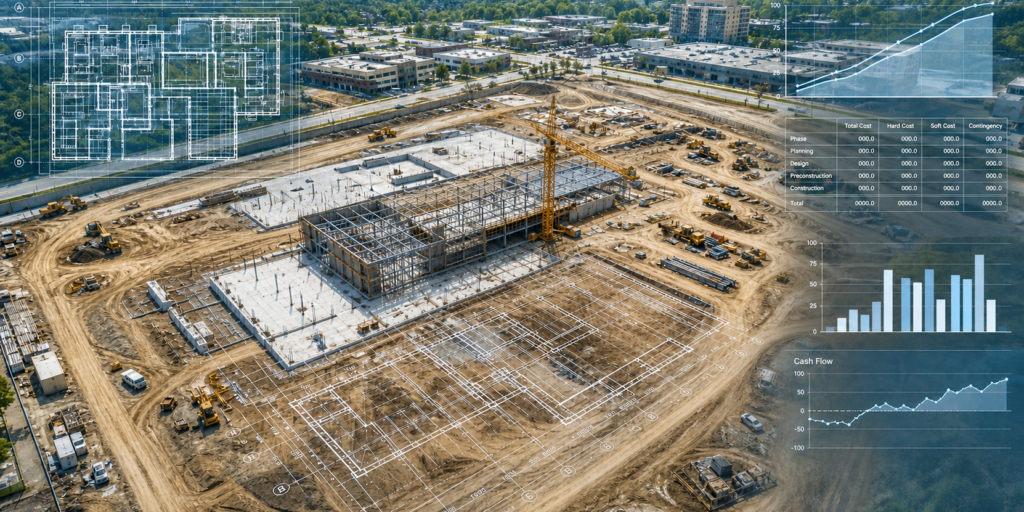
Multifamily development involves a series of decisions about cost, density, design, parking, and financial performance. Each decision affects the others, so evaluating a project requires looking at more than one number.
Multifamily development metrics give owners and developers a common way to compare sites and concepts, understand tradeoffs, and determine whether a project supports their business plan.
DBS Group uses these metrics during predevelopment to test financial feasibility, guide initial design, and shape preliminary budgets while owners can still adjust the concept.
Start with the ownership model
Before evaluating the numbers, consider how the property will be owned and operated.
Multifamily developments may include rental properties, condominiums, cooperatives, or individually owned units. The ownership model can affect financing, design, amenities, utilities, maintenance responsibilities, and long-term operations.
A rental townhome development, for example, may have different design and operational priorities than individually owned townhomes. Establishing the ownership model puts the other metrics in context.
Understand cost per unit
Total project cost matters, but it doesn’t show how effectively a concept uses development dollars.
Total cost per unit compares overall development cost with the number of units created. Land cost per unit helps evaluate how productively a site is being used. Hard cost per unit focuses on construction and can show the added cost of elevators, structured parking, or more complex building systems.
Comparing projected monthly rent per unit with total development cost per unit offers an early revenue check, while the full financial model accounts for operating expenses, financing, and returns.
DBS Group compares building and site concepts with preliminary costs and projected revenue to guide design before major commitments.
Measure building efficiency and unit mix
Not every square foot of a building produces revenue.
Gross square feet per unit, gross rentable square feet, net rentable square feet, and circulation efficiency help show how effectively the building uses space. Corridors, stairs, elevators, mechanical rooms, amenities, and common areas are necessary, but they also add cost.
Unit mix matters as well. The number and size of one-, two-, and three-bedroom units can affect construction cost, building footprint, parking demand, potential rents, and marketability.
Bringing design and estimating together early allows DBS Group to test these variables against both the project budget and the owner’s goals.
Evaluate density and parking together
Units per acre measures residential density, while floor area ratio (FAR) compares total building floor area with the size of the site. Both help developers understand how intensively a property is being used.
More density can make sense when land is expensive or limited, but it may also introduce additional construction and parking costs.
That’s why you should evaluate parking ratio and parking type as part of the density strategy. Surface parking generally costs less but uses more land. Tuck-under, underground, detached garage, structured, and off-site parking each have different implications for cost, site circulation, stormwater management, resident experience, and achievable density.
DBS Group compares these alternatives during predevelopment to understand their effects on cost, revenue potential, and the overall concept.
Connect design decisions to financial performance
Financial key performance indicators (KPIs) help determine whether the project can meet owner, lender, and investor expectations.
Common multifamily development KPIs include:
- Yield on cost: Stabilized net operating income compared with total development cost.
- Cash-on-cash return: Annual cash flow relative to cash invested.
- Internal rate of return (IRR): Expected annualized return over a defined period, accounting for the timing of cash flows.
- Debt service coverage ratio (DSCR): The property’s ability to cover debt obligations with operating income.
- Equity multiple: Total cash returned relative to equity invested.
Developer fees, management fees, and utility arrangements such as ratio utility billing systems (RUBS) can also affect the financial model.
These aren’t separate from design and construction decisions. Changing the unit mix can alter rent potential. Changing the parking strategy can affect both cost and density. Improving building efficiency may increase rentable area.
Use the metrics to test the project
No single multifamily development metric determines whether a project works. Cost, building efficiency, unit mix, density, parking, and financial performance need to be evaluated together.
That’s where an integrated design-build approach can be particularly useful. DBS Group brings design, estimating, project management, field operations, and consultants together during predevelopment to test financial feasibility against site constraints, budget, schedule, and market demand.
As one variable changes, the team can assess its effect on revenue, cost, and performance, then adjust the design and preliminary budget before making major commitments.